
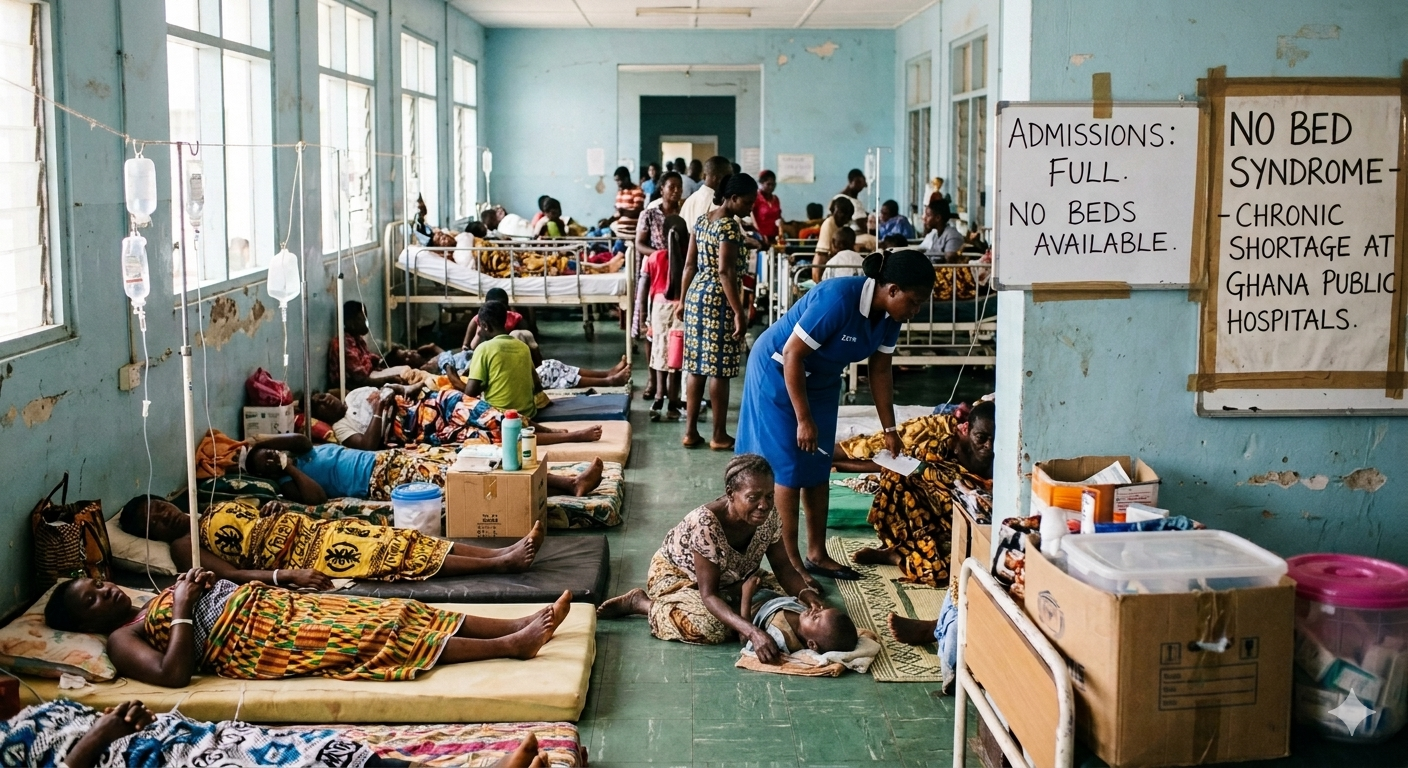
Ghana stands at crossroads burdened by decades of structural under-investment, a chronic workforce deficit, a disease burden shifting toward non communicable diseases, and a National Health Insurance Scheme struggling to fulfil its mandate. We also gather at a moment of possibility a moment when a government committed to free primary healthcare, a mobilized student body, and a workforce ready to lead can together chart a different course.
SETTING THE SCENE: THE NO BED SYNDROME
Let me begin with a story that many Ghanaian know too well not from a textbook, but from lived experience. “There is no bed.” These four words — uttered in government hospitals, district health centres, and regional facilities across this country have become a sentence of despair for hundreds of thousands of Ghanaians. They have meant the difference between life and death for mothers in labour, for children in acute respiratory distress, for elderly men with uncontrolled hypertension, and for young trauma victims. The “No Bed Syndrome” is not merely a logistical inconvenience. It is the most visible symptom of a deeply fractured health system one that has, for decades, over-invested in curative, hospital-centric care while neglecting the foundational infrastructure of primary healthcare.
It is not simply a conference title. It is a distress signal. It is the cry of a mother who Laboured for 14 hours only to be told there is no bed. It is the frustration of a child with malaria turned away from a facility with no drugs. It is the despair of a diabetic patient walking six kilometres to a clinic only to find no clinician on duty
The 2022 Ghana Health Service Annual Report noted that bed occupancy rates at major teaching hospitals in Accra and Kumasi routinely exceed 100%, with Korle Bu Teaching Hospital recording bed occupancy as high as 115% in some wards. Patients are placed on floors, in corridors, and in makeshift arrangements that violate every standard of dignified care.
But the No Bed Syndrome is only the headline. The body of the story is even more troubling and it begins long before patients ever reach a hospital.
THE NUMBERS THAT TELL OUR STORY: GHANA’S HEALTH SYSTEM IN DATA
Workforce Deficit
Ghana currently has approximately 1.5 physicians per 10,000 population — far
below the WHO minimum threshold of 10 per 10,000. Our nurse-to-population ratio stands at approximately 13.4 per 10,000, against the recommended 25.
These are not abstract statistics; they translate into clinics without clinicians, wards without nurses, and communities without care. Yet buried within these troubling numbers is a critical but often overlooked truth:
Ghana has over 7,000 trained physician assistants known in our regulatory
framework functioning as first-contact primary care providers in communities from Navrongo to Nkwanta.
When we include nurses, midwives, and allied health professionals, the frontline primary care workforce numbers in excess of 60,000.
These are the true architects of Ghana’s primary healthcare.
Disease Burden and Healthcare Utilisation
malaria remains the leading cause of outpatient morbidity, accounting for
approximately 28% of all outpatient department (OPD) visits.
Non-communicable diseases hypertension, diabetes, cancer, and chronic respiratory diseases now
account for 43% of all deaths, a proportion that has more than doubled over two decades according to the Ghana Statistical Service.
The National Health Insurance Scheme (NHIS) coverage currently stands at approximately 40% of the population, with active membership likely lower. Approximately 33.8% of total health expenditure in Ghana comes from out-of-pocket payments a figure that pushes an estimated 1 million Ghanaians into catastrophic health expenditure each year.
Maternal mortality stands at approximately 308 deaths per 100,000 live births as of the most recent Ghana Demographic and Health Survey (GDHS). Under-five mortality is approximately 48 per 1,000 live births. Both figures, while improved from prior decades, remain unacceptably high and largely preventable through robust primary care. 3.3 Infrastructure Deficits Ghana has approximately 2.9 hospital beds per 1,000 population against the WHO
recommendation of 3.0 a figure that conceals extreme geographic inequity: while Greater Accra has 4.5 beds per 1,000, the Upper West Region has barely 1.0. Of the approximately 3,700 CHPS compounds targeted for construction, nearly 40% remain either non-functional or unstaffed, according to the Ministry of Health’s 2023 Annual Programme of Work.
About the Author
